
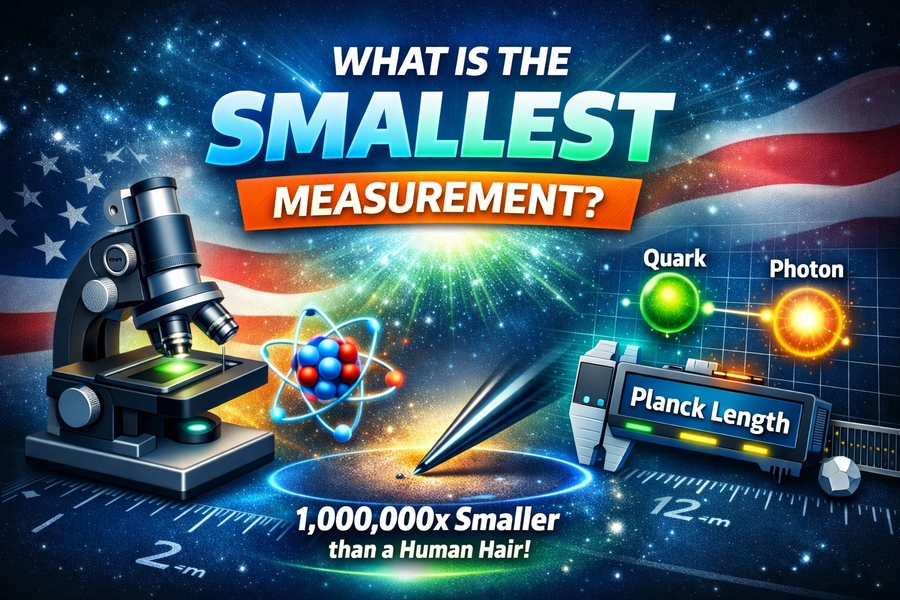
When we think of measurements, we usually consider units like inches, feet, and meters, which are familiar in daily life. However, there are far smaller measurements used in science, technology, and other fields that stretch the boundaries of what we can physically perceive. So, what exactly is the smallest measurement? The answer depends on the context in which it’s used.
At the most basic level, the smallest units we encounter regularly are in the metric system, including millimeters, micrometers, and nanometers. But as we dive deeper into the world of quantum mechanics and theoretical physics, we encounter even smaller units, such as the Planck length, a value that represents the limit beyond which current theories break down.
Understanding these measurements requires exploring the diverse systems that help scientists and engineers accurately define the world at both macro and micro scales.
Smallest Units in Everyday Life
In everyday life, we typically measure small lengths in units like millimeters (mm), micrometers (µm), and nanometers (nm). These units help us measure things that are too small to be seen with the naked eye but are crucial in industries such as manufacturing, medicine, and technology.
For example, a millimeter is 1/1,000th of a meter and is often used to measure objects like the thickness of paper or the width of small components in machinery. The micrometer is 1/1,000th of a millimeter, and it’s used for measuring even smaller objects, such as hair strands or the components in a microchip.
Nanometers are even smaller, measuring 1/1,000,000th of a millimeter. These are essential in fields like nanotechnology, where incredibly small components like quantum dots and semiconductor elements are measured. As technology advances, the need to understand these units becomes more important in industries ranging from electronics to medicine. You can read more about the importance of small measurements in nanotechnology by visiting articles on specialized tools like Instant Measurement Converter.
The Role of Microscopic Units in Science
When discussing microscopic units, the micrometer and nanometer are just the beginning. As technology advances, we need even more specialized tools to measure objects on the atomic or subatomic scale. At this scale, units like angstroms (1/10th of a nanometer) and picometers (1/1,000th of a nanometer) are crucial in fields like chemistry and physics, especially when studying the properties of atoms and molecules.
The angstrom unit is often used in material science, where scientists measure atomic bonds in crystals. These tiny distances are crucial for understanding the behavior of materials at the molecular level. Similarly, picometers help researchers study the small forces that influence atomic structures, a topic that’s essential in quantum physics.
While these measurements are still part of the macroscopic world, they hint at the tiny scales that govern the universe at its most fundamental levels. Understanding these units is essential for scientific advancements in medicine, electronics, and even space exploration.
The Quantum World and the Planck Length
As we move from the microscopic into the quantum world, we encounter the Planck length, a value so small that it challenges our understanding of space and time. The Planck length is roughly 1.6 x 10^-35 meters, and it represents the smallest possible length according to current scientific theory. Below this threshold, the conventional laws of physics as we know them no longer apply.
In quantum mechanics, the Planck length is seen as the scale at which space-time becomes “quantized,” meaning the continuous fabric of space-time breaks down into discrete units. This length is so small that it’s impossible to measure with any technology available today. Even the most advanced tools, like the Instant Measurement Converter, can’t measure this tiny distance due to the limitations of current measurement technologies.
Theoretical physics suggests that below this scale, space itself behaves differently, and concepts like distance and time lose their usual meaning. This fascinating idea is central to many areas of physics, especially in research related to string theory and the nature of black holes.
Practical Applications of Tiny Measurements
While the Planck length remains largely theoretical, smaller measurements have practical applications in a variety of fields. For example, in the manufacturing and semiconductor industries, engineers often deal with components measured in nanometers. A semiconductor transistor, which is the heart of modern electronics, might be just a few nanometers in size.
Similarly, in medicine, imaging technologies like MRI and X-rays rely on the ability to measure small distances in the body, such as the width of blood vessels or the dimensions of a tumor. With smaller and more precise measurements, doctors can diagnose and treat diseases more effectively, using highly detailed scans that target the smallest structures within the body.
In materials science, the ability to manipulate structures at the nanometer scale has led to the creation of stronger, more efficient materials. These advances are especially important in fields like aerospace engineering and nanotechnology, where materials with specific properties are necessary for building everything from spacecraft to high-performance electronics.
Measuring the Unmeasurable
As we look beyond conventional measurements, we start to encounter the limits of what can be measured. The Planck length represents a threshold where traditional measurement techniques break down. While this length may never be directly measurable, its importance in theoretical physics cannot be overstated.
In fields like cosmology and quantum mechanics, understanding the behavior of objects at the Planck scale could unlock answers to some of the most profound questions in science. Theoretical models like string theory rely on the idea that space-time at the quantum level behaves in a way that can only be understood by examining the smallest possible units.
These advancements are pushing the boundaries of our knowledge and raising new questions about the fundamental nature of reality itself. For anyone interested in the future of science and technology, it’s important to keep track of how these measurements evolve. In fact, tools like the Instant Measurement Converter are helping bridge the gap between everyday measurements and those needed for the most advanced technologies.
How Tiny Measurements Shape Our Future
Looking ahead, it’s clear that tiny measurements will continue to play an important role in the development of new technologies. Whether it’s creating faster computers, improving medical imaging, or exploring the universe at its most fundamental level, our ability to measure at extremely small scales will shape the future of innovation.
By continuing to refine our methods of measurement, scientists and engineers can create more efficient and powerful tools that will help solve problems we haven’t yet imagined. In many cases, the smallest measurements hold the key to the biggest breakthroughs, whether it’s in the development of new drugs or the exploration of other planets.
Moreover, understanding these small units isn’t just for scientists. In everyday life, as technologies continue to improve, we may find ourselves using more and more precise measurements, from nanotechnology in consumer electronics to more detailed medical diagnoses.
Conclusion
The smallest measurement can vary depending on the field of study, but the most fundamental units are those that are crucial for scientific research, from the micrometer to the Planck length. These measurements are key to understanding the universe, from the smallest atoms to the vastness of space itself. While we may never directly measure the Planck length, it represents the limits of our understanding and the boundaries of modern physics.
The ability to measure at such minute scales opens up a world of possibilities in fields like technology, medicine, and engineering, shaping the future of innovation. As we continue to explore these microscopic worlds, the tools and methods we use will evolve, pushing the boundaries of what we can measure and understand.